

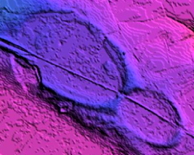

Oblique Impact Cratering Characteristics
Imaging of the surface areas of our solar system's terrestrial planets and moons has show that approximately 5% of all craters are created during low angle of incidence [oblique] impacts. These events create a set of recognizable characteristics: oval shape, butterfly ejecta pattern, "no-fly" ejecta area up field, and "blow-out" rim down field. These are sometime seen in a "train" of craters, where the impactor had been fragmented into a stream of individual components due to atmospheric disruption or Roche tidal disruption prior to impact.
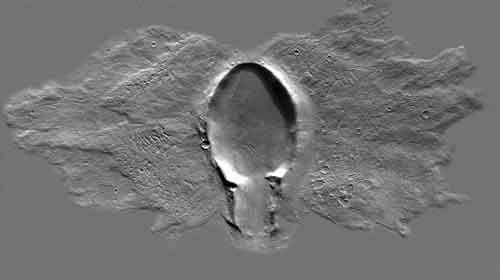
Example Mars Impact with Butterfly Ejecta distribution
Credit: NASA / JPL / ASU / mosaic by Emily Lakdawalla
Oblique Impact Crater on Mars
Owing to the atmospheric drag, a string of fragmented impactors would differentiate during decent, with the larger bodies tending to travel further than smaller ones.We call special attention to the work of Schultz and Stickle (Lost Impacts), which explains how shallow angle of incidence (oblique) impacts generate "impact" structures that are significantly different from the classic, better understood, crater planforms. We proposed the Saginaw impacts to have been at an angle of less than 5 degrees - nearly tangential. The craters generated would manifest themselves as quite shallow and as elongated ovals. Their experiments using the NASA Ames Vertical Gun Range were limited in scope, as the gun's lower limit of rotation is 15 degrees. We have noted other work where the experimenter had tilted the target table to reach angles of 5º. To model a true tangential strike, a spherical surface target table would be required.
The sub-pages in this section discuss several of these characteristics as imaged by remote sensing systems.
We are currently researching the Saginaw Bay area as a possible oblique impact site a cometary body. Our current proposal holds that the impact carved out much of the current bedrock topography of the Michigan basin surrounding and west of the Saginaw Bay. Local ejecta, distributed in a butterfly pattern, was heaped on top of the then-present Wisconsin ice sheet. As the sheet melted beneath the ejecta blanket, many of the enigmatic "moraines", hummocks and tunnel landforms were created. Eventually, the large lake created within the ice sheet crater catastrophically drained southward, creating the Central Kalamazoo River Valley (CKRV).
Deadly Impacts
It seems impossible to believe now, but the concept of impact cratering on Earth was soundly rejected by the scientific establishment during the first half of the 20th century. Eugene Shoemaker changed all that when he made direct and powerful comparisons between the geological structures of Berringer’s Crater in Arizona, and the nuclear test craters he had been documenting for the US Government. The National Geographic film Asteroids: Deadly Impact discusses his work, and the breakthroughs he was directly responsible for. The story is a lesson in the debate between the uniformitarian establishment and the catastrophist outsiders. We suggest that even today — 50 years on — the full suite of impact cratering mechanisms has not been fully investigated.